
PORTFOLIO
Bharath K Baiju
A Junior digital marketer transitioning from operations, building hands-on experience in Social media, Google Ads, SEO, web design, and analytics through practical, project-based work.
Featured Projects
A collection of strategic digital marketing projects demonstrating campaign planning, audience research, content strategy, and performance analysis.
Social Media Strategy & Content Calendar
Content strategy brief and 4 week calendar for a Fictional Coffee Shop, with sample posts.
Content Strategy
Social Media
Google Ads Campaign Project
Google Ads
Bid Strategy
Search campaign structure, keyword targeting, and ad copy for a sample business
Personal Website
Personal brand positioning, content pillars, and SEO setup behind the site you’re on now.
Personal Branding
SEO
Fictional Case Study
Note: This is a fictional portfolio project created to demonstrate social media strategy, content planning, audience research, customer journey mapping, and performance measurement. No real client data or campaign results are presented.
Project Overview
Brew & Bloom is a fictional specialty coffee shop located in Dubai, serving single-origin coffee, espresso-based drinks, freshly baked pastries, and weekend coffee cupping workshops.
The objective of this project was to develop a one-month Instagram content strategy that aligned with measurable business goals rather than simply increasing posting frequency or engagement.
Business Challenges
The cafe faced two key business challenges:
- Low weekday morning foot traffic.
- Low bookings for weekend coffee cupping workshops.
The marketing strategy also needed to operate within several practical constraints:
- Organic social media only (no paid advertising)
- Limited marketing budget
- Smartphone photography and video production
- Small team with limited content creation capacity
Business Objectives
Objective 1
Increase weekday morning customer visits by attracting nearby office professionals during commuting hours.
Objective 2
Increase bookings for weekend coffee cupping workshops through educational and promotional Instagram content.
Audience Research
Primary Audience
Office professionals working near the café.
Characteristics
- Ages 22–40
- Commute to work on weekdays
- Purchase coffee before work
- Active Instagram users
- Value convenience, quality, and café atmosphere
Secondary Audience
Coffee enthusiasts interested in learning more about specialty coffee.
Characteristics
- Interested in coffee culture
- Enjoy cafe experiences
- Likely to attend workshops
- Engage with educational coffee content
Content Strategy
The content strategy was built around four content pillars, each supporting a different business objective.
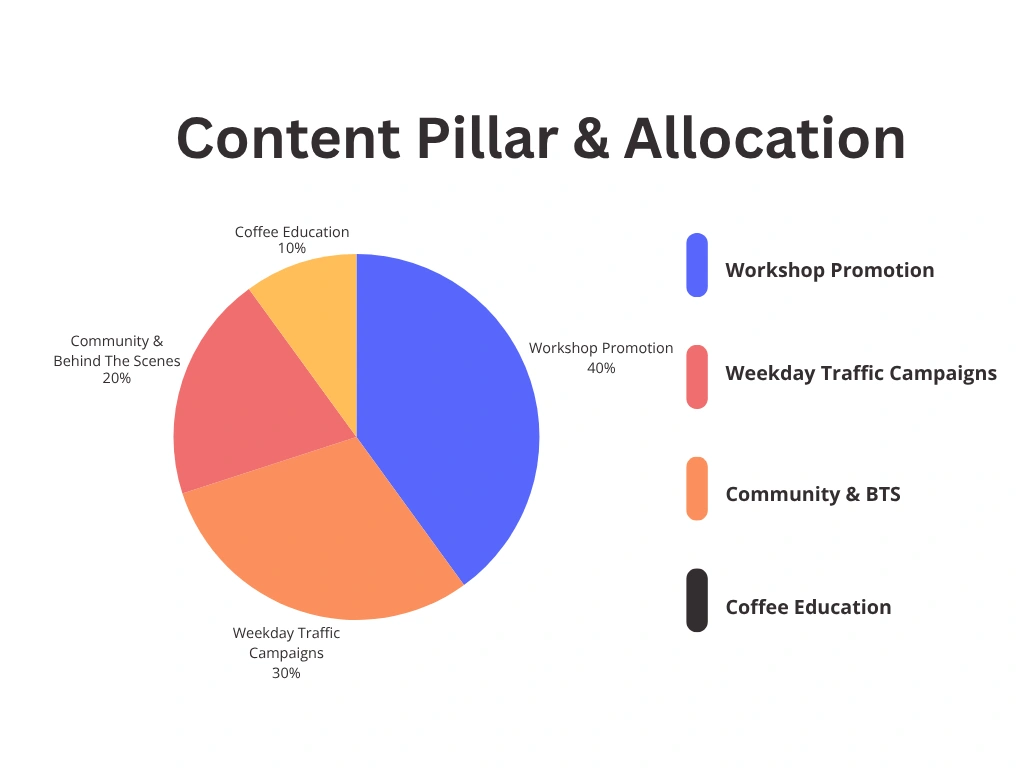
1. Workshop Promotion (40%)
Purpose
Increase awareness and bookings for weekend coffee workshops.
Content Examples
- Workshop previews
- Previous attendee testimonials
- Limited-seat reminders
- Booking call-to-actions
2. Weekday Traffic Campaigns (30%)
Purpose
Increase weekday morning foot traffic.
Content Examples
- Coffee and breakfast promotions
- Morning routine Reels
- Workday-focused messaging
- Convenience-driven content
3. Community & Behind-The-Scenes (20%)
Purpose
Build trust by showcasing the people behind the brand.
Content Examples
- Barista introductions
- Daily cafe operations
- Customer interactions
- Cafe atmosphere
4. Coffee Education (10%)
Purpose
Position Brew & Bloom as a specialty coffee destination while supporting workshop interest.
Content Examples
- Coffee origin stories
- Bean comparisons
- Brewing tips
- Coffee facts
Customer Journey Strategy
Content was intentionally scheduled throughout the week to guide followers through the customer journey.
- Monday: Awareness
- Tuesday: Interest
- Wednesday: Education
- Thursday: Consideration
- Friday: Conversion
This structure ensures promotional content is supported by educational and trust-building content before asking users to take action.
Weekly Content Calendar
|
Day |
Content |
Format |
|
Monday |
Coffee & Breakfast Promotion |
Static Post |
|
Tuesday |
Day In The Café Reel |
Reel |
|
Wednesday |
Ethiopian vs Colombian Coffee |
Carousel |
|
Thursday |
Coffee Workshop Preview |
Carousel |
|
Friday |
Workshop Booking CTA |
Static Post |
|
Saturday |
Live Workshop Coverage |
Stories + Live |
|
Sunday |
Weekend Café Moments |
Stories |
Instagram Stories Strategy
Daily Instagram Stories were designed to reinforce feed content while encouraging audience interaction.
Planned story formats included:
- Polls
- Questions
- Behind-the-scenes moments
- Workshop countdown stickers
- Customer interactions
- Live workshop coverage
Example Story Ideas
- “Coffee before work or after lunch?” poll
- Workshop countdown
- Meet the Barista
- Coffee trivia quiz
- Customer testimonials
KPI Framework
Business KPIs
The primary success metrics focused on measurable business outcomes:
- Workshop bookings
- Workshop capacity utilization
- Morning revenue
- Morning transaction volume
Marketing KPIs
Supporting marketing metrics included:
- Reach
- Reel views
- Story engagement
- Link clicks
- Saves
- Shares
- Direct messages
Attribution Strategy
To better understand campaign effectiveness, multiple attribution methods were included.
- Self-reported customer surveys
- Instagram link tracking
- Workshop inquiry tracking
- UTM parameter implementation
- Website booking analytics
Deliverables
This project included:
- Audience research
- Customer personas
- Content pillar strategy
- Customer journey mapping
- 30-day content calendar
- KPI framework
- Attribution plan
- Instagram content mockups
- Content pillar pie chart
- Week 1 content calendar
- Performance reporting framework

Key Takeaways
This project demonstrates the ability to build a social media strategy that aligns content with business objectives rather than vanity metrics.
By combining audience research, customer journey mapping, structured content pillars, and measurable KPIs, the strategy creates a clear path from awareness to conversion while supporting long-term business growth.
Google Ads Search Campaign - Brewhaven Coffee Co.
Fictional Case Study
Note: This is a fictional portfolio project created to demonstrate Google Ads campaign planning, account structure, keyword strategy, bidding methodology, ad creation, and performance reporting. No real client data or live campaign results are presented.
Project Overview
Brewhaven Coffee Co. is a fictional specialty coffee brand offering two core products:
- Coffee Subscription – $24/month recurring subscription
- Single Bag Purchase – $18 one-time purchase
The business had previously relied on organic social media and influencer marketing, with no existing Google Ads account or historical conversion data.
The objective was to design a Google Ads Search campaign with a $3,000 monthly budget that could efficiently generate subscription sign-ups and one-time purchases while establishing a scalable account structure for future optimization.
Challenge
Although both products belong to the same business, they represent two completely different customer journeys.
A recurring subscription generates significantly higher long-term value than a single bag purchase, meaning each conversion can justify a different acquisition cost.
The challenge was to build an account structure that separated user intent, bidding strategy, messaging, and performance measurement without creating unnecessary complexity.
Strategy
Campaign Structure
A single Search campaign was created with two intent-based ad groups:
- Coffee Subscription
- Single Bag Purchase
Instead of organizing the account by product category, the structure focused on customer intent and conversion value, allowing each ad group to have its own messaging, keyword targeting, and CPA goals.
Bidding Strategy
The campaign followed a two-phase Smart Bidding approach.
Phase 1 – Maximize Conversions
The campaign launched using Maximize Conversions without a CPA target, allowing Google Ads to collect sufficient conversion data before applying bid constraints.
Phase 2 – Target CPA
After gathering enough conversion data, the plan was to transition to Target CPA.
Estimated CPA targets were based on business economics:
- Subscription: $30–36 CPA (approximately 25% of a six-month customer lifetime value)
- Single Purchase: $6–8 CPA (aligned with profit margins on an $18 purchase)
Target ROAS was intentionally not selected because each conversion within an ad group had a consistent value, making CPA optimization the more appropriate strategy.
Keyword Strategy
The keyword strategy prioritized Phrase Match to maintain search relevance while still allowing controlled reach.
A small set of high-intent Exact Match keywords was included for tighter bidding control.
Negative keywords were implemented to:
- Remove low-intent searches
- Exclude informational queries
- Prevent overlap between the two ad groups
- Reduce wasted spend
Campaign Execution
The project included:
- Complete keyword research for both ad groups
- Phrase Match and Exact Match keyword lists
- Negative keyword strategy
- Responsive Search Ads with 15 headlines and 4 descriptions per ad group
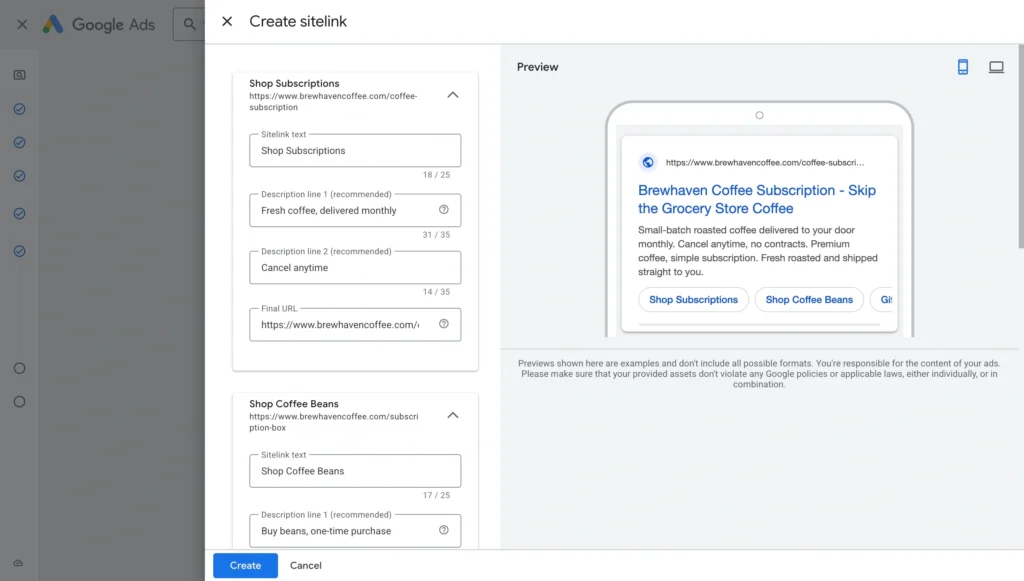
- Sitelink Assets
- Callout Assets
- Structured Snippet Assets
- Price Assets
- Campaign structure diagram
- Search ad mockup
- Monthly reporting dashboard
- Performance reporting template
Key Performance Indicators
During the learning phase, the campaign focused on:
- Conversions
- Cost per Conversion
- Click-Through Rate (CTR)
- Impression Share
After the learning phase, optimization would focus on:
- Actual CPA vs Target CPA
- Conversion growth
- Budget allocation
- Search term analysis
- Performance comparison between Subscription and Single Purchase ad groups
Weekly reviews would monitor search terms and campaign pacing, while monthly reports would summarize performance, insights, and recommended optimizations.
Illustrative Performance Scenario
A hypothetical Month 1 report was created to demonstrate campaign analysis.
- Subscription Ad Group: Achieved a CPA within the target range of $30–36.
- Single Purchase Ad Group: Recorded a CPA significantly above the target range.
Rather than treating this as a failure, the result highlights an important optimization decision:
Should the CPA target remain unchanged, or should customer lifetime value and cross-sell potential justify a higher acquisition cost?
This demonstrates how campaign performance should guide strategic decisions rather than simply measuring success or failure.
Deliverables
- Google Ads account structure
- Campaign strategy
- Smart Bidding framework
- Keyword research
- Responsive Search Ads
- Asset creation
- Campaign structure diagram
- Search ad mockup
- Performance reporting dashboard
- Monthly performance report
Key Takeaways
This project demonstrates the ability to:
- Design scalable Google Ads account structures
- Align bidding strategies with business objectives
- Build intent-based keyword strategies
- Write effective Responsive Search Ads
- Create supporting campaign assets
- Plan meaningful performance reporting
- Interpret campaign data to inform future optimization
Personal Website - Bharathkavithabaiju.com
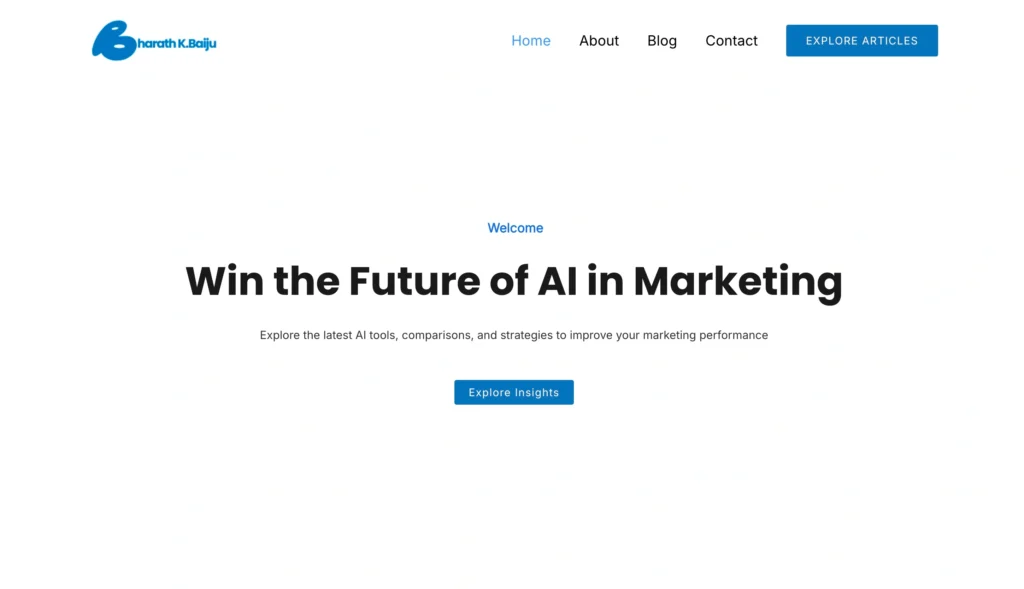
Live Project
Note: Unlike the other two case studies, this is not fictional, it’s a real, live website you can visit right now.
Project Overview
This site was built to publish original content at the intersection of AI and marketing, breaking down AI tools, workflows, and use cases specifically for marketers who are still figuring out how to use them. The site runs on four sections: Home, About, Blog, and Contact, with the Blog as the core of the project and a Portfolio page included to showcase supporting case study work.
The Challenge
AI in marketing is a crowded, fast-moving topic, most content on it is either too technical for beginners or too generic to be useful. The goal was to carve out a specific angle: practical, beginner-friendly breakdowns of AI tools and how marketers can actually use them, rather than surface-level “AI is changing marketing” takes. This meant:
- Building and maintaining the entire site solo, with no-code tools
- Establishing a clear content angle and voice from the first post
- Handling the technical side (structure, SEO, indexing) without a developer
- Creating a platform that could grow post by post, not a one-time project
Strategy & Execution
Site Architecture Built on WordPress using Elementor, structured around four core sections – Home, About, Blog, Contact designed to be simple to navigate and easy to keep updating with new posts.
Content Strategy Started with a beginner-focused comparison post “ChatGPT vs Claude for Marketing Beginners (2026)” tackling a genuinely useful, high-search-intent question: which AI tool should a marketer with no technical background actually use, and why. The post is written to help beginners choose confidently rather than get lost in feature comparisons.
Technical Maintenance Ran a full site audit to catch and fix technical SEO issues, including missing meta tags, incorrect noindex settings, and broken footer links, to keep the site properly indexed and discoverable as new content gets added.
Deliverables
- Full site build (WordPress + Elementor)
- Content strategy and angle for the blog
- First published post: “ChatGPT vs Claude for Marketing Beginners (2026)”
- On-page SEO setup and technical audit fixes
- Portfolio page (separate section) showcasing case study projects
Key Takeaways
This project demonstrates the ability to identify a content gap, build a platform from scratch to fill it, and publish with a clear, consistent angle, while also handling the technical groundwork (SEO, site structure, indexing) needed to keep it discoverable. It’s an ongoing project, not a one-off: the plan is to keep publishing on AI-in-marketing topics as the space evolves.
Certifications
- Google Ads Search Certification – Google Digital Academy (Skillshop)
- Google Ads Mastery Course – Senator We Run Ads
- Content Marketing Certification – HubSpot Academy
- Social Media Marketing Certification – HubSpot Academy
- Fundamentals of Marketing Analytics – Semrush
- Advanced Digital Marketing – HACA
Tools I Use
- Google Ads
- Google Analytics
- Semrush
- Notion
- Canva
- CapCut
- Chatgpt
- Claude
- DaVinci Resolve
- Midjourney
Social Media Strategy & Content Calendar - Brew & Bloom